

For the past two years, AI web development articles followed a predictable script: small models are coming, agentic AI will change everything, quality content will win. That script is now out of date.
In November 2026, the conversation has moved from speculation to consequence. AI agents are live. Search traffic is under pressure. Inference costs are a line item in every product budget. If you're building or maintaining a website, the question isn't whether AI will affect you—it's whether your current setup can survive what's already happening.
Here's what the data and the market are telling us, and what it means for your web strategy going into 2027.
The Agentic Web Is Real (And It's Messy)
For years, "agentic AI" was a slide in a conference deck. Today, it's a live variable in how users find and consume content.
AI agents are beginning to skip sponsored listings, negotiate transactions on behalf of users, and bypass the traditional ad-supported web model that most publishers and e-commerce sites depend on. This isn't a future scenario. It's a structural shift that's already forcing platforms to rethink how they monetize attention.

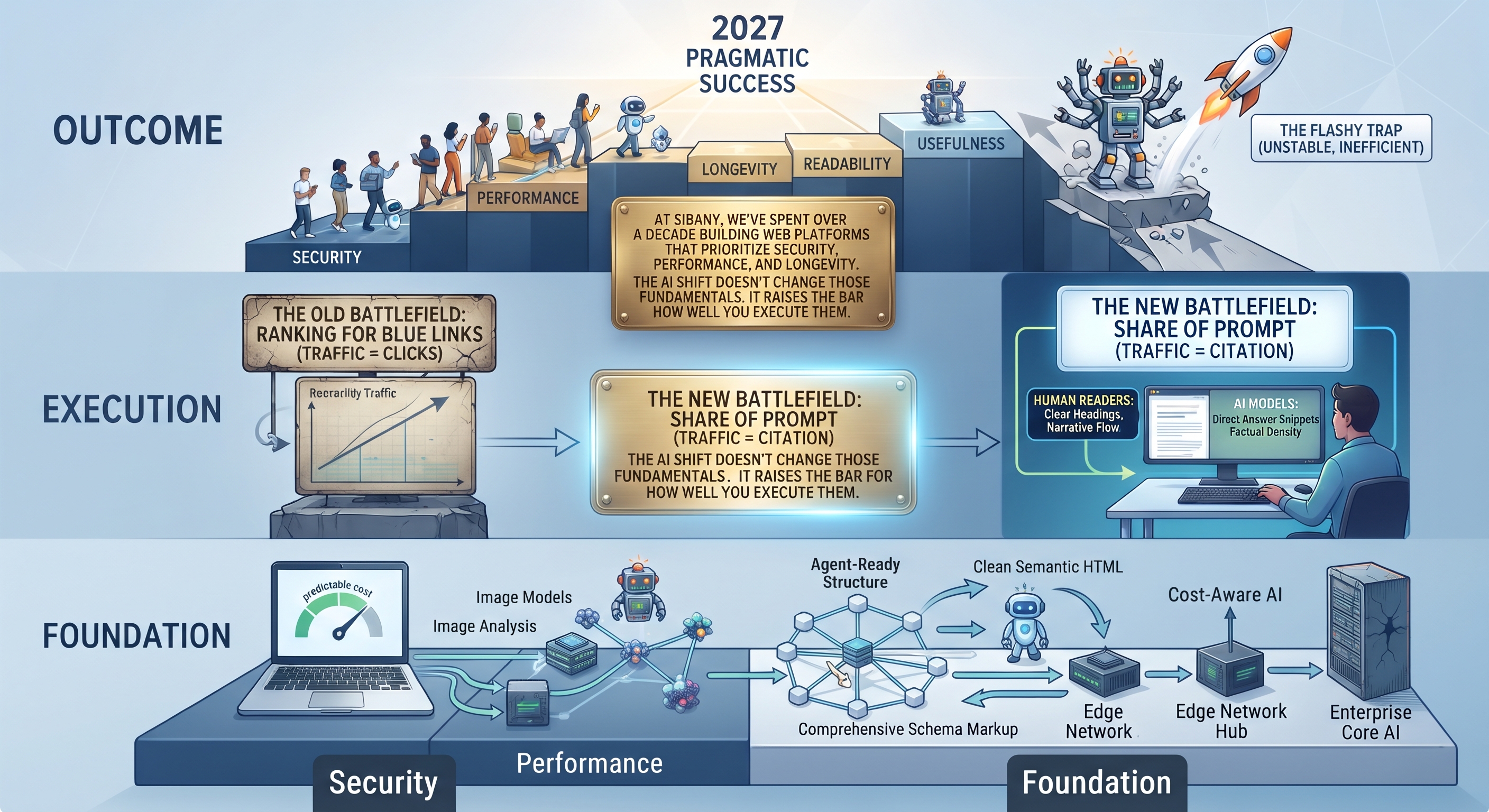
What this means for your site: If your business model relies on capturing clicks through traditional search or display advertising, agentic intermediaries are a direct threat. The defensive play is structured, machine-readable content—clean semantic HTML, schema markup, and APIs that agents can consume without needing to render your entire page.
The W3C has been working on Agentic Web standards, and forward-looking development teams are already auditing their sites for "agent-readability" the same way they audited for mobile responsiveness a decade ago.
Search Traffic Is the New Battlefield
The SEO advice from early 2026—"focus on quality content"—wasn't wrong. But it undersold the severity of the shift.
Google's AI Overviews now appear in a significant share of searches, and referral traffic to many publishers has dropped sharply as users get answers without clicking through. The old model of optimizing for a blue link is giving way to a new metric: share of prompt. The question is no longer "do I rank?" but "am I the source the AI cites?"

Practical implication: Your content strategy needs to serve two audiences simultaneously—humans who land on your page and the models that summarize it. That means clear headings, direct answers near the top, and factual density that AI systems can extract reliably. It also means accepting that some content exists to be cited, not clicked.
Google has begun testing features like Preferred Sources to give publishers more control, but the fundamental asymmetry remains: the platform controls the interface, and you control the substance. Invest accordingly.
The Inference Cost Crunch Is Reshaping Architecture
Early AI web features were often built without a clear cost model. That era is over.
Token costs are now a design constraint. Every AI-powered personalization feature, chatbot, or content generator has a per-interaction cost that scales with usage. For sites with meaningful traffic, the difference between a clever feature and a sustainable feature is often a matter of inference efficiency.
This is where the small-model story finally becomes practical. Compact models running on edge infrastructure or even client-side via Web Assembly can handle many tasks—image analysis, basic classification, accessibility enhancements—without a round trip to an expensive API. The win isn't novelty; it's cost predictability.

McKinsey's 2026 research found that only a small fraction of companies report meaningful EBIT impact from AI. The gap isn't ambition—it's architecture. Teams that treat AI as an integrated, cost-aware layer rather than a bolt-on feature are pulling ahead.
What's Actually Worth Building Now
Strip away the hype, and three practical priorities emerge for web teams in late 2026:

1. Agent-ready structure. Clean semantic HTML, comprehensive schema markup, and stable URLs. This is unglamorous work, but it's the foundation for being readable by both search engines and AI intermediaries.
2. Cost-aware AI features. Before adding an AI feature, ask: what does it cost per user, per session, per month? If the answer is unclear, the feature isn't ready. Edge models and client-side inference should be the default consideration, not the exception.
3. Content that earns citation. Original data, clear methodology, and direct answers. The publishers surviving the traffic shift are those whose content is worth referencing, not just ranking.
The Bottom Line: Pragmatism Wins
The AI conversation in web development has finally grown up. The winners in 2027 won't be the sites with the flashiest AI demo or the most aggressive automation. They'll be the sites that remain fast, readable, and useful—for humans and for the agents acting on their behalf.
At Sibany, we've spent over a decade building web platforms that prioritize security, performance, and longevity. The AI shift doesn't change those fundamentals. It raises the bar for how well you execute them.
Ready to audit your site for the agentic web? Let's talk about what needs to change before the next traffic shift hits.
Questions about AI-ready web development? Get in touch - we read everything.